
The Lyric and Letter Study Method
Go Slow. Study Deep. Be Transformed
A DEEPER WAY TO STUDY
What if you could read the Bible and understand it in a way you never have before?
Not as a collection of verses to look up when life gets hard. Not as a devotional you skim before the day starts. But as what it actually is: a living, intentional, perfectly directed narrative, written by an Author who knew exactly what He was doing in every scene, every word, every thread.
That is what this method is about.
It started on a living room floor in 2008, in a Saturday study community where we sat on couches and floors, shared a meal, and studied Scripture the way it was meant to be studied — slowly, communally, with deep attention to its cultural and historical roots. Years later, working as a filmmaker, I recognized that what we had been doing around that table was the same instinct I used on a film set: breaking down a scene, asking who is present, what they're carrying, where they are in the story emotionally and spiritually, and why it's there at all. The language was different. The instinct was the same.
Out of the cultural roots, the communal study, the filmmaker's eye, and years of inductive discipline, the Lyric and Letter Study Method took shape. It is not a replacement for the Holy Spirit. It is not a scholarly system. It is a way of slowing down and reading Scripture as the living, intentional narrative it is, with something to say directly to you.
And it begins the same way every time. Not just with your Bible open, but with your heart and mind open to what the Holy Spirit wants to transform in you.
"For the word of God is living and active, sharper than any two-edged sword." — Hebrews 4:12
LEARNING THE METHOD
1. PRAY FIRST
Before you open your Bible, open your heart. Invite the Holy Spirit, your Teacher, into the room. This is not a ritual — it's a theological necessity. Without Him you are doing literary analysis. Interesting, maybe. But not transformative.
2. READ THE PASSAGE
Read it fresh. No commentary, no study notes, no teaching playing in the background — just you, the text, and the Holy Spirit. Write your raw observations and questions exactly as they come, without editing yourself. Then read it again in a second translation and notice where the wording shifts. That gap is almost always where the depth is hiding. Hold your first impressions with an open hand. They are seeds to test in the steps ahead, not conclusions to settle here.
3. EXPLORE THE CONTEXT
Before you study the words, study the setting. What's the historical and cultural backdrop? What comes before this passage, and what comes right after? What's the atmosphere — the mood, the tension, the stakes in the air? A verse pulled out of its scene can be made to say almost anything. A verse inside its scene reveals exactly what the Author intended. Let the text show you what's there rather than adding to it.
4. NOTICE WHAT'S HAPPENING
Now examine the scene you've entered. Work through who, what, when, where, and why, slowly and deliberately, the way Moses turned aside at the burning bush — not out of duty, but out of a genuine desire to understand what God is saying. These questions get you inside the text and onto the holy ground of His Word.
5. FINISH YOUR STUDY (optional)
Gather what you want to carry forward. Follow cross-references — where else in Scripture does this theme, phrase, or pattern show up? Jot down anything further the Spirit surfaced that doesn't fit neatly into the steps above. Some days this step is exactly what your study needs. Other days the Spirit has already said what needed saying, and you can close in prayer instead.
6. HOW'S GOD SPEAKING?
This is where study becomes a conversation. How does this passage fit into the whole story that leads to Christ — not by forcing Him into a verse that's doing something else, but by letting each passage take its own place in the one story that arrives at Him? How is God's character being revealed? How is the Holy Spirit speaking to you personally, in a way that agrees with what the passage actually means? And how does God want you to respond to what you've just read?
7. RENEWING YOUR MIND
This is the step most people skip. It's also the step that makes everything else matter. What do you need to surrender to the Lord? Not a generic application point, but something specific and honest. What are your next steps moving forward — concrete enough that you'd know if you actually did them this week? Then close in prayer, thanking God for what He showed you and praying the passage back into your daily walk.
On days when you can linger, walk the whole path. On busier days, one step is enough — pray, and read the passage. That's a complete and worthy time in Scripture. The steps are a map, not a measuring stick. The goal was never to finish the worksheet. The goal is to meet God in His Word and be changed by Him.
THE FULL INSTRUCTION GUIDE
The complete Lyric and Letter Study Method is a free nineteen-page guide. Inside you'll find the full story of how this method developed, detailed teaching on all seven steps, a worked example from Genesis 1 showing exactly what each step looks like in practice, printable daily study pages to guide you through your own passage, and a complete list of recommended resources — physical Bibles, digital tools, and a note on using AI study companions well, without letting them sit in the seat that belongs to the Holy Spirit and the Word.
It's grounded in Scripture, oriented toward Christ, and built for the woman who is ready to stop skimming and start inhabiting God's Word.
Go Slow. Study Deep. Be Transformed.
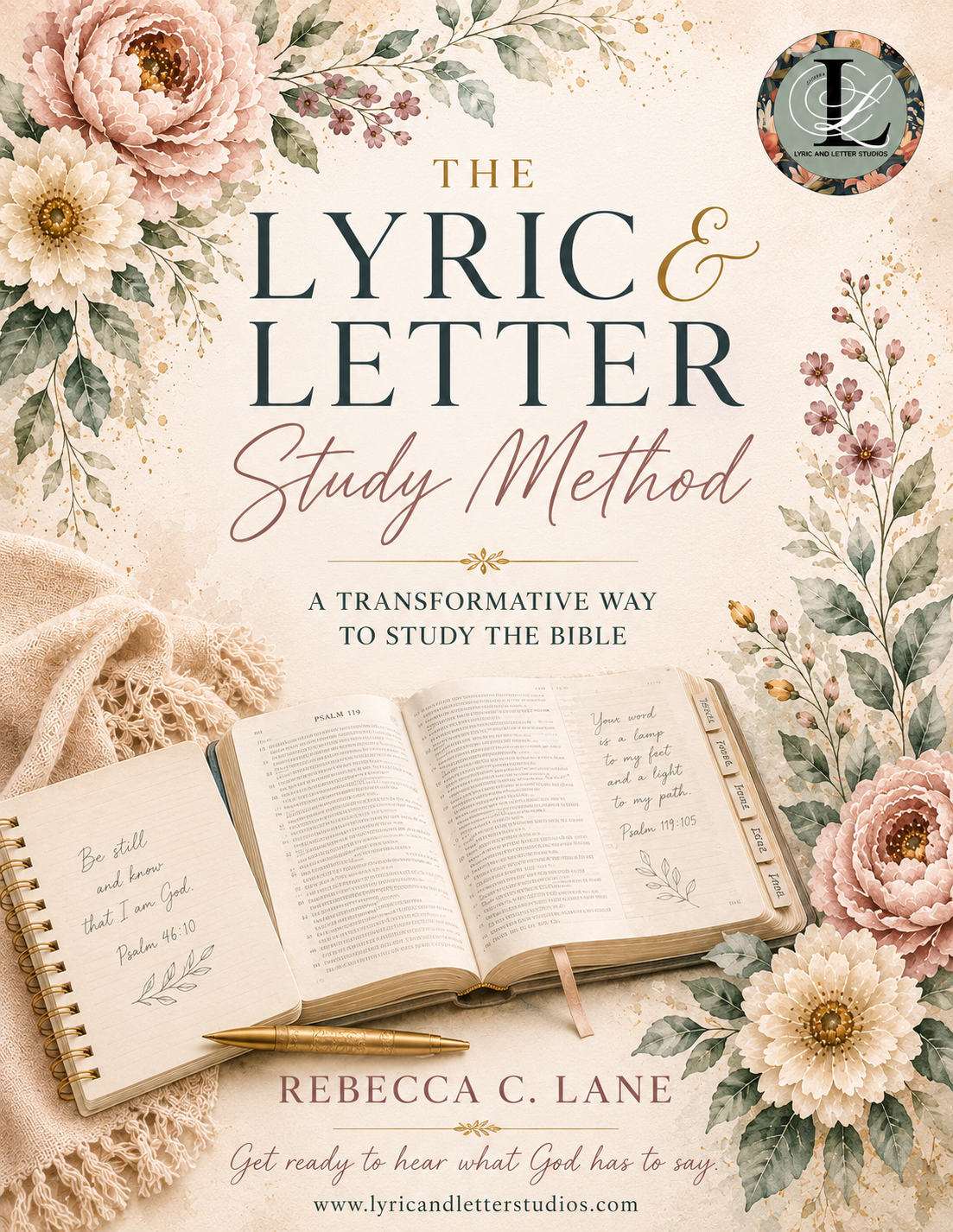
Want to truly understand the Bible and walk alongside the Author who wrote it?
The Lyric and Letter Study Method is a free nineteen-page guide walking you through a seven-step inductive approach to Scripture, grounded in Scripture itself, oriented toward Christ, and built for the woman who is ready to stop skimming and start inhabiting God's Word.
Inside you'll find the full method with detailed teaching on each step, a worked example from Genesis 1 showing exactly what it looks like in practice, printable daily study pages to walk through your own passage, and a complete resource list, including a note on why your physical Bible still matters more than any screen.
Once you've walked the method on paper, you can bring it to life inside the Lyric & Letter Companion Study App at app.lyricandletter.com. The app carries you through these same seven steps with Theo, a study companion built specifically for this method, on hand for Steps 2 through 6 to help with observation, context, and connections. Your opening prayer and closing response stay exactly what they should be: yours, and the Holy Spirit's. You can save every study as you go and return to it whenever you want.
Go slow. Study Deep. Be Transformed
OTHER STUDY METHODS
The Lyric and Letter Method is the path I walk and teach, and I hope you'll make it your own. But it isn't the only outline worth knowing. Here are four others, each with a different rhythm, in case one meets you where you are this season.
SOAP
for the woman who wants to get back to basics
Developed by Pastor Wayne Cordeiro of New Hope Christian Fellowship, and first laid out in his book The Divine Mentor.
S — Scripture. Write out the passage by hand, or a verse or two if it's long. Something happens when you slow down enough to copy it word for word.
O — Observation. What's actually happening here? Who's speaking, who's listening, what's the setting. Stay with the facts before you jump to meaning.
A — Application. What does this show you about God, about people, about sin — and what's one specific way to live it out this week?
P — Prayer. Thank God for what He showed you, and ask Him to help it take root.
→ Learn more: https://www.wearecrossroads.org/soap
APPLE
for the woman who wants a clear checklist to work through
Grab your colored pencils for this one — it's a method built for marking up the page.
A — Attributes of God. What does this passage show you about who God is?
P — Promises of God. What has He said He will do? Not every passage has one — that's fine, keep moving.
P — Principles for Life. What's simply true here — true about life in general, not just this moment in the text?
L — Lessons Learned. What is this passage teaching, correcting, or warning you about?
E — Example to Follow. Is there someone in this text whose response to God is worth imitating?
→ Learn more: https://www.youministries.com/blog
TEXT
for the woman who wants to get straight to the heart of it
Built by the makers of the TEXT Bible, a study Bible with passages already broken into sections for you.
T — Talk to God. Before you read a word, ask Him to open your eyes to what's here.
E — Encounter God and humanity. What does this passage reveal about who God is, and about His dealings with people?
X — eXamine your heart. Where do you see yourself in this text — your circumstances, your need, your resistance?
T — Talk to others. Thank God for what He showed you, and ask for a chance to pass it on.
→ Learn more: textbible.com