

When God's Word Confronts the Culture Around Us and the Compromise Within Us
In 2007, I entered a three-day Esther fast with a heart burdened by the culture around me and a deep desire to examine my own heart before the Lord. At the time, conversations about marriage, morality, and the political direction of our nation were becoming increasingly divisive, particularly where I lived in California. But my fasting wasn't simply about what was happening in society or which political direction our country might take. I was seeking God's face in repentance, asking Him to examine my beliefs, expose anything within me that was contrary to His Word, and reveal whether my convictions were truly grounded in Scripture or being influenced by the culture in which I lived.
During that time of prayer, a question was impressed upon my heart that I understood to be from the Spirit of God. It was a question that would remain with me for nearly twenty years, although I could not have imagined how deeply it would eventually confront my own life.
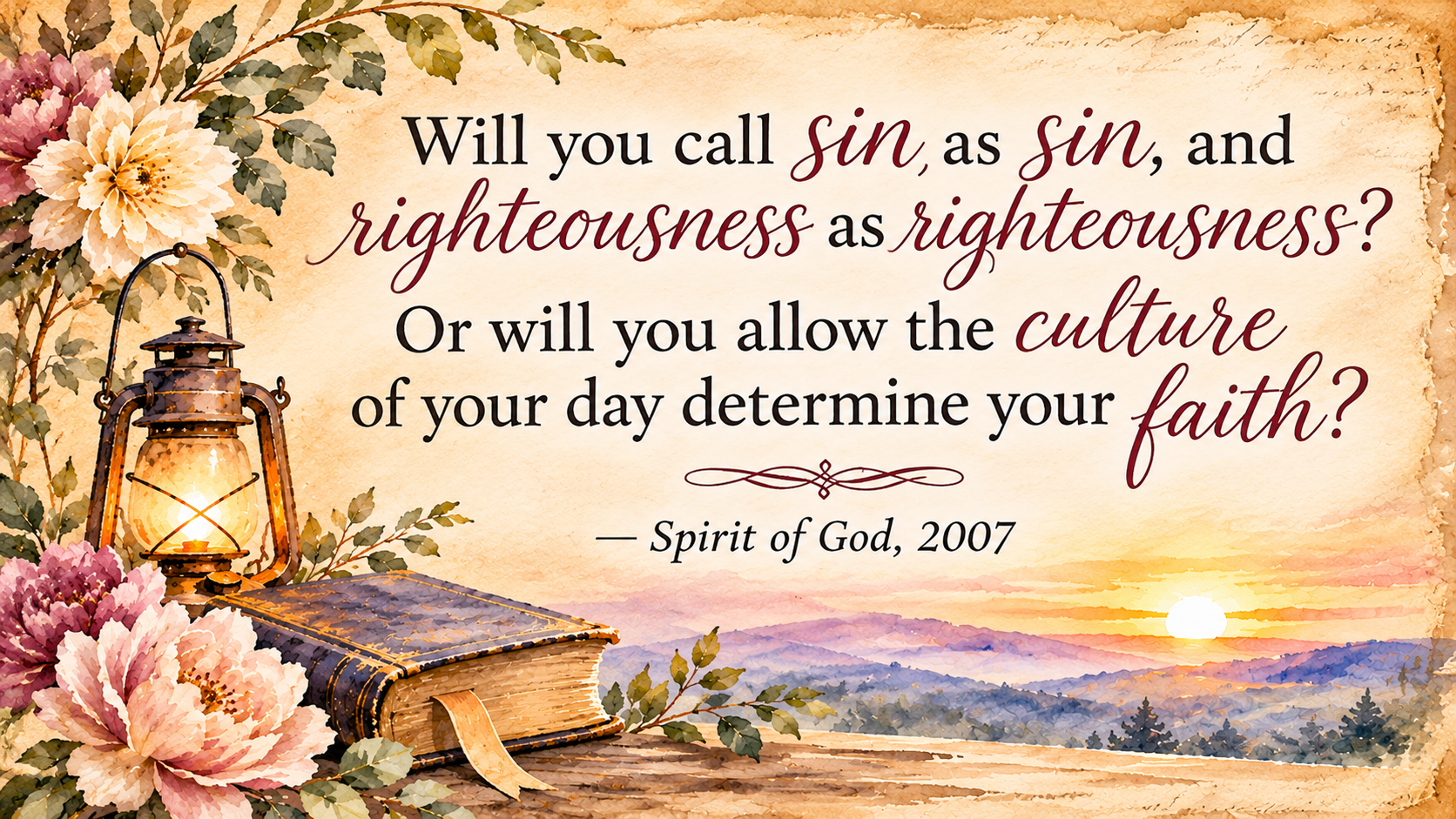
“Will you call sin as sin, and righteousness as righteousness? Or will you allow the culture of your day determine your faith?”
Spirit of God, 2007
At the time, I understood this as a call to stand faithfully upon the authority of God's Word, regardless of how society might redefine morality or challenge biblical convictions. I wanted my faith to be rooted in the unchanging character of God rather than the shifting opinions of the world. Yet as I reflect upon those words today, I recognize something deeply humbling. There were seasons in my life when I did the very thing I believed God was warning me against.
I allowed cultural influences to shape some of my convictions, even in areas where I knew Scripture spoke clearly. I experienced profound grief following the death of my husband, and in that grief, I allowed bitterness, disappointment, and spiritual confusion to draw me away from the Lord. There were times when I sought answers outside of Scripture and embraced beliefs and practices that I now recognize were contrary to the faith I professed. I cannot attribute those decisions entirely to grief or the influence of culture, because ultimately, I was responsible for the choices I made.
Looking back, I can see how easily the human heart can begin accommodating what God has called us to reject, especially when our emotions, relationships, or circumstances make obedience difficult. What began as a question about remaining faithful in the face of cultural pressure eventually became a mirror through which I would have to examine my own compromises.
And that is why three passages of Scripture have become particularly meaningful to me as I reflect upon that question: Isaiah 5:20, Romans 12:2, and John 17:14–19. Together, they reveal the danger of redefining good and evil, the necessity of renewing our minds through God's truth, and the beautiful work of sanctification that Christ accomplishes in those who belong to Him.
When We Begin Calling Evil Good: Isaiah 5:20
In Isaiah 5:20, the prophet delivers a sobering warning to the people of Judah:
“Woe to those who call evil good and good evil, who put darkness for light and light for darkness, who put bitter for sweet and sweet for bitter!” (Isaiah 5:20, ESV)
To appreciate the weight of this warning, we need to consider the historical and literary context in which Isaiah spoke. The people of Judah were not strangers to God's covenant or His commandments. They had received His instruction, witnessed His faithfulness throughout their history, and understood that they were called to live as a people set apart for Him. Yet Isaiah 5 reveals a nation increasingly characterized by greed, injustice, drunkenness, arrogance, and the rejection of God's revealed will.
Earlier in the chapter, Isaiah presents the song of the vineyard, describing Israel and Judah as God's carefully cultivated planting. The Lord had provided everything necessary for His vineyard to produce good fruit, yet instead of justice and righteousness, He found bloodshed and an outcry (Isaiah 5:1–7). This imagery establishes the foundation for the judgments that follow. The problem was not that God had failed to reveal His expectations, but that His people had failed to respond faithfully to what He had revealed.
By the time we reach verse 20, Isaiah exposes something particularly troubling. The people were not merely participating in unrighteousness; they were reversing the moral distinctions God had established. What was evil was being called good, and what was good was being treated as evil. Isaiah emphasizes this inversion through three contrasting pairs: good and evil, light and darkness, and bitter and sweet. Each contrast demonstrates the absurdity and danger of exchanging God's standards for human judgment.
The chapter eventually identifies the underlying problem in verse 24, where Isaiah declares that the people had rejected the law of the LORD of hosts and despised the word of the Holy One of Israel. Their moral confusion was rooted in their rejection of divine revelation. Rather than allowing God's Word to define righteousness, they had elevated their own desires and judgments above His instruction.
As I consider this passage, I find it tempting to immediately apply it to the world around us. Certainly, we can observe countless examples of moral confusion within contemporary culture. Yet Isaiah was addressing a people who possessed God's revelation, and that should cause those of us who profess faith in Christ to examine ourselves before we begin pointing toward others.
How often do we make exceptions for behaviors that Scripture clearly identifies as sinful because those behaviors have become socially acceptable? How frequently do we reinterpret difficult passages because their teachings challenge our relationships, political loyalties, personal experiences, or desires? We may never openly declare that God's Word is wrong, yet we can gradually diminish its authority by allowing something else to determine how we understand and apply it.
I recognize this tendency because I have seen it in my own life. There were times when I allowed my circumstances and emotions to influence what I was willing to accept as truth. Rather than bringing those feelings before the Lord and submitting them to Scripture, I sometimes sought beliefs that accommodated what I wanted to believe. It was not always a deliberate rejection of God's Word. Sometimes it was a gradual willingness to compromise, one decision at a time, until I found myself embracing things I once knew were contrary to Scripture.
Isaiah's warning reminds me that righteousness is not determined by cultural consensus, personal sincerity, or even the strength of our convictions. God alone establishes what is good and what is evil, and His revealed Word is the authority by which our judgments must be tested. The question, therefore, is not simply whether our culture has abandoned biblical morality, but whether we ourselves have remained faithful to the truth God has revealed.
The Renewal of Our Minds: Romans 12:2
The apostle Paul addresses this struggle from another perspective in Romans 12:2:
“Do not be conformed to this world, but be transformed by the renewal of your mind, that by testing you may discern what is the will of God, what is good and acceptable and perfect.” (Romans 12:2, ESV)
What makes this passage especially meaningful is its placement within Paul's letter to the Romans. For the first eleven chapters, Paul has carefully unfolded the gospel, explaining humanity's universal condition under sin, the righteousness of God revealed through faith in Jesus Christ, justification by grace, union with Christ, and the extraordinary mercy of God in His redemptive purposes. When Paul reaches chapter 12, he begins explaining how those who have received God's mercy are called to live in response to it.
His appeal begins with the words, “I appeal to you therefore, brothers, by the mercies of God” (Romans 12:1, ESV). The command to live differently is not presented as a means of earning salvation, but as the appropriate response of those who have already received God's mercy through Christ. Paul calls believers to present their bodies as living sacrifices, holy and acceptable to God, describing this as their spiritual worship. Our worship, then, is not confined to songs, gatherings, or moments of prayer. It encompasses the surrender of our entire lives to the Lord.
Within that context, Paul commands believers not to be conformed to this world. The Greek verb syschēmatizesthe (συσχηματίζεσθε), translated “be conformed,” conveys the idea of being fashioned according to a pattern. The word translated “world” in this verse is aiōn (αἰών), which refers here to the present age and its prevailing patterns of thought and conduct. Paul's warning is that believers must not allow the values and assumptions of this fallen age to become the pattern by which their lives are shaped.
But Paul does not stop with the command to resist conformity. He immediately presents the positive alternative: “Be transformed by the renewal of your mind.” The Greek verb metamorphousthe (μεταμορφοῦσθε), translated “be transformed,” describes a profound change. Rather than merely adjusting outward behavior, Paul is speaking of an inward transformation that changes how believers think, evaluate, and respond to the world around them.
This distinction is important because biblical faithfulness is not simply about refusing to participate in certain cultural practices or maintaining a particular set of moral positions. It involves the ongoing transformation of our thinking so that our understanding of life becomes increasingly aligned with God's revealed will. As our minds are renewed, we grow in our ability to discern what is good, acceptable, and pleasing to Him.
I find this particularly convicting when I consider how easily we can allow our political affiliations, relationships, personal experiences, and emotional responses to influence our interpretation of Scripture. We may approach God's Word with conclusions we have already formed and then search for passages that appear to support them, rather than allowing Scripture to challenge and correct our thinking. When we do this, we have subtly reversed the proper relationship between God's authority and our own understanding.
No political party, cultural movement, denomination, or personal experience possesses the authority to define righteousness. Even convictions we have held for many years must remain subject to examination in the light of God's Word. Scripture is not something we reshape to accommodate our beliefs; it is the truth by which our beliefs must continually be measured.
This is why the renewal of our minds cannot be reduced to a single moment of repentance or a decision we made many years ago. My three-day fast in 2007 did not somehow guarantee that I would remain immune to compromise in the years that followed. I still needed to remain rooted in Scripture, dependent upon the Lord, and willing to receive correction when my thinking began drifting away from His truth.
The Christian life requires ongoing submission to God's Word, not because His truth changes, but because our hearts and minds are continually in need of correction and growth. We must be willing to ask whether our convictions are being shaped by Scripture or whether we have gradually allowed the surrounding culture to influence what we believe.
And yet, even as Romans 12:2 calls us to transformation, we must remember that this transformation is not something we accomplish through determination alone. The renewal of our minds is part of God's sanctifying work in those who belong to Christ, which brings us to one of the most beautiful prayers recorded in Scripture.
Sanctified in the Truth: John 17:14–19
In John 17, we are invited into an extraordinary moment as Jesus prays to the Father shortly before His arrest and crucifixion. Often referred to as His High Priestly Prayer, this chapter reveals the heart of Christ for those who belong to Him. As He prepares to accomplish the work of redemption, He prays for His disciples, knowing they will remain in a world that stands in opposition to Him.
Jesus declares in verse 14:
“I have given them your word, and the world has hated them because they are not of the world, just as I am not of the world.” (John 17:14, ESV)
The distinction Jesus makes is not merely between religious people and an unbelieving society. He is describing the spiritual identity of those who have received the Father's Word and belong to Him. The Greek word kosmos (κόσμος), translated “world,” can refer to different things depending upon its context. Here, it describes the fallen world in its opposition to God and His truth.
Because the disciples belong to Christ, they are no longer defined by the world's values and allegiances. Yet Jesus does not pray that the Father would remove them from the world. In verse 15, He specifically asks that they be kept from the evil one, and in verse 18, He explains that just as the Father sent Him into the world, He has sent His disciples into the world.
This reveals something essential about the Christian calling. We are not commanded to withdraw from society or isolate ourselves from everyone who does not share our beliefs. Neither are we permitted to compromise God's truth in order to gain acceptance. Instead, we are called to live faithfully within the world while remaining set apart in our allegiance to Christ.
And how does Jesus pray that His disciples will be set apart?
“Sanctify them in the truth; your word is truth.” (John 17:17, ESV)
The Greek verb hagiazō (ἁγιάζω), translated “sanctify,” means to set apart or consecrate for a holy purpose. Jesus asks the Father to sanctify His disciples in the truth, and then He identifies the source of that truth: the Father's Word.
This is a remarkable statement because Jesus does not leave the definition of truth to human opinion, cultural consensus, or individual experience. He grounds it in the revelation of God Himself. The disciples are to be set apart through the truth they have received, and that truth is inseparable from the Word the Father has given.
For those of us who desire to remain faithful in an ever-changing culture, this prayer provides both instruction and encouragement. Our calling is not to develop a form of holiness based upon personal preference or religious tradition. We are to be shaped by the truth of God's Word, allowing it to expose our sin, correct our thinking, and direct our lives toward obedience to Christ.
But there is another detail in this passage that I find especially beautiful. In verse 19, Jesus says:
“And for their sake I consecrate myself, that they also may be sanctified in truth.” (John 17:19, ESV)
Jesus is speaking of His own consecration to the Father's saving purpose, which He is about to fulfill through His sacrificial death. His disciples' sanctification is therefore inseparable from His redemptive work. The One who calls us to holiness is also the One who has accomplished what was necessary to reconcile us to God.
This prevents us from turning biblical faithfulness into an exercise in self-righteousness. We do not stand before God because we have perfectly resisted cultural influence or because our convictions have never wavered. We stand before Him through the righteousness of Jesus Christ, who has redeemed us by His blood and continues His sanctifying work in those who belong to Him.
When I consider the years in which I wandered from the Lord, this truth brings me tremendous gratitude. My failures were real, and the compromises I made were not insignificant. Yet the gospel reminds me that my hope has never rested upon my ability to remain perfectly faithful. My hope rests upon the finished work of Christ, whose grace calls sinners to repentance and whose truth continues to transform His people.
Standing Firm in the Strength of the Lord
As I reflect upon these passages together, I am reminded of Paul's exhortation in Ephesians 6:10–14, where he calls believers to be strong in the Lord and in the strength of His might, taking up the whole armor of God so that they may withstand in the evil day and stand firm.
The imagery of standing firm is particularly meaningful when considering the question I encountered in 2007. At the time, I understood that faithfulness would require me to resist the pressure to redefine sin and righteousness according to the prevailing culture. What I did not fully appreciate was how deeply I would need to depend upon the Lord's strength to remain steadfast, particularly when suffering, grief, and disappointment entered my life.
Paul does not instruct believers to stand in their own moral superiority, intellectual ability, or determination. He calls them to be strong in the Lord. The armor he describes is God's provision for His people, and truth occupies a foundational place within that imagery.
This is an important reminder because it is possible to become so focused upon identifying the sins of the surrounding culture that we fail to recognize the sin within our own hearts. We can defend biblical morality publicly while privately resisting the very correction God's Word brings to our lives. We can become more concerned with winning arguments than with demonstrating the humility, love, and holiness that should characterize those who belong to Christ.
Scripture does not permit us to separate truth from godliness. In Ephesians 4:15, Paul speaks of truth being expressed in love, while 2 Timothy 2:24–25 instructs the Lord's servant to correct opponents with gentleness. Biblical faithfulness requires both unwavering commitment to God's revealed truth and a manner of life that reflects the character of the Savior we proclaim.
Standing firm, therefore, is not simply about refusing to change our convictions. It is about remaining submitted to Christ, allowing His Word to correct us, and depending upon His strength as we seek to live faithfully in a world that often rejects His authority.
Nearly Twenty Years Later, the Question Remains
When I look back upon that three-day fast in 2007, I recognize that the question impressed upon my heart was far more personal than I understood at the time. I was seeking the Lord in repentance, asking Him to examine my heart in the face of a changing culture, and expressing my desire to remain faithful to His Word. Yet in the years that followed, I would discover how easily grief, disappointment, personal desires, and cultural influence could lead me away from the very convictions I had once sought to preserve.
I cannot change those years, nor can I undo the decisions I made. But I can acknowledge my sin, repent, and return to the truth of God's Word with a renewed understanding of my dependence upon Christ. First John 1:9 reminds us that God is faithful and just to forgive those who confess their sins and to cleanse them from all unrighteousness. Romans 8:1 assures us that there is no condemnation for those who are in Christ Jesus. These promises do not minimize the seriousness of sin; they magnify the sufficiency of the Savior who bore its penalty.
And perhaps that is one of the most important lessons I have learned through this journey. The purpose of biblical discernment is not merely to become better at recognizing what is wrong with the world around us. It is to bring every part of our own lives under the authority of God's Word so that we might increasingly reflect the character of Jesus Christ.
Isaiah reminds us that we must never reverse God's definitions of good and evil. Romans teaches us that we must not allow the present age to shape our thinking, but instead be transformed through the renewal of our minds. And in John 17, Jesus reveals that His people are sanctified in the truth of God's Word and sent into the world as those who belong to Him.
Together, these passages remind me that faithfulness is not measured by how loudly we condemn the culture, but by whether our own hearts, convictions, and conduct remain submitted to the Lord.
Nearly twenty years later, I still find myself returning to that question:
“Will you call sin as sin, and righteousness as righteousness? Or will you allow the culture of your day determine your faith?”
Today, I understand that answering it requires more than affirming the authority of Scripture with my words. It requires a willingness to be corrected by that same Scripture, to repent when I have compromised, and to surrender my own understanding to the truth God has revealed.
My desire is not to stand upon the strength of my convictions, but upon the faithfulness of Jesus Christ. I have learned that my own resolve can falter, my understanding can become clouded, and my heart can be drawn away when I fail to remain rooted in His Word. Yet Christ remains faithful, and His truth does not change with the passing of generations or the shifting values of society.
As I continue walking with the Lord, my prayer is that I would never become so concerned with the sins of the culture that I neglect to examine my own heart. May I remain teachable before His Word, humble in repentance, steadfast in truth, and dependent upon the grace of the Savior who has called me to Himself.
For the question was never simply whether the world would remain faithful to God's truth. The question was whether I would.
And by His grace, I desire to stand.
“Sanctify them in the truth; your word is truth.”
John 17:17, ESV
Go slow. Study deep. Be transformed.
Scripture for further study: Isaiah 5:1–24; Romans 12:1–2; John 17:14–19; Ephesians 4:15; Ephesians 6:10–18; 2 Timothy 2:24–25;
1 John 1:9; Romans 8:1.
