

Watering the Desert
Hello Friends,
First, forgive my silence here on the blog. It has been far too long since I have sat down and written to you this way. As many of you know, the brain injury I sustained this summer has taken a lot more out of me than I ever expected. I am still working, still studying, and still showing up in the places God has given me to show up, but I am learning that my brain simply does not have the same capacity it had before the injury. Things that once required very little thought can now require an enormous amount of mental energy, and writing has been one of the places where I have had to give myself permission to go slowly.
So please forgive the quiet here. I haven't stopped leading or writing, and I certainly haven't stopped loving this little community. In many ways, God has been doing some very tender work in me during the quiet, and this past weekend some of that work came together in a way I wasn't expecting.
This weekend, I attended the Women of Worship Fall 2026 Retreat. It was a wonderful and refreshing time to connect with God and one another. Early in the weekend, we were given an exercise they called “prophetic art.” The invitation was simply to pray and ask the Lord what we might paint. For me, this was not about receiving some new revelation from God or trying to predict anything. It became a visual way of praying and reflecting on what I believe the Lord has been teaching me through His Word and through this ministry.
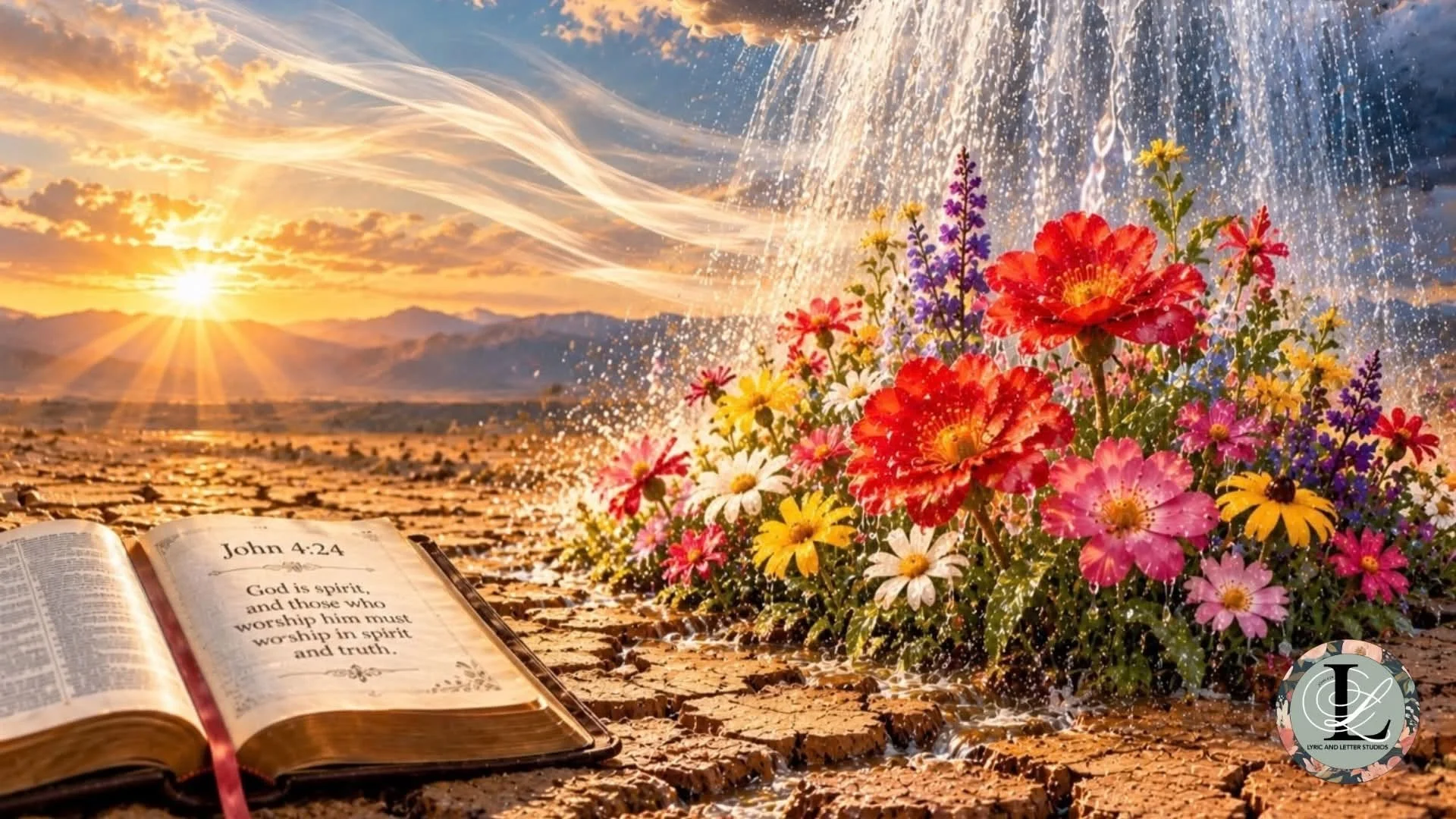
And this is the picture that came to mind.
I painted dry, cracked ground. At first, it was simply the landscape, but as I continued painting, I knew exactly what that ground represented. It was me.
Dry ground really cannot produce anything on its own. It cannot make itself fertile, summon the rain, or force something beautiful to grow from itself. It is simply ground, completely dependent upon what is given to it. And strangely, that was such a freeing picture of how I have begun to see my place in this ministry.
Then I painted the flowers, and those flowers were all of you. Each flower was different, with different colors, different sizes, and different places in its growth. Over the flowers I painted what looked almost like an atmospheric river, water pouring down from above and drenching them. As I painted it, I could picture the Lord watering each of you through His Word. Not because of me or because of something clever I have created, and certainly not because I somehow possess what you need. The water comes from Him.
I may help tend the ground. I may open the Bible with you, ask questions, trace themes, follow cross-references, or sit beside you at the Quiet Table, but God is the One who gives the growth. Paul said it so beautifully in 1 Corinthians 3:6: “I planted, Apollos watered, but God gave the growth.”
Here was the part of the picture that affected me most. As the water poured over the flowers, it didn't only water them. It began soaking the dry ground beneath them. The very water that was helping the flowers grow was also softening the ground, and I realized that is what has been happening to me.
As I watch you grow in your hunger for Scripture, I am changed. When I watch you discover something in the Word, ask a question, chase a cross-reference, wrestle with a difficult passage, or suddenly see Christ somewhere in the storyline of Scripture, God uses it to soften me. Your growth has become part of the way He continues to work on my own heart. I thought I was helping cultivate a place where other women could grow in the Word, and all along, God has been using those same waters to cultivate me.
On the left side of the painting, I painted wind moving through the scene toward the flowers. Scripture often uses the imagery of wind in connection with the Spirit. Jesus Himself uses that imagery in John 3:8 when He says, “The wind blows where it wishes, and you hear its sound, but you do not know where it comes from or where it goes.” For me, the wind became a reminder that this ministry ultimately belongs to God.
I cannot manufacture spiritual life. I cannot transform anyone's heart, and I cannot make Scripture bear fruit in another person. Only God can do that. My responsibility is simply to remain faithful to His Word, point people toward Christ, and trust the Holy Spirit to accomplish what only He can accomplish.
That is also why the open Bible in the picture matters so much to me. John 4:24 says, “God is spirit, and those who worship him must worship in spirit and truth.” Spirit and truth. The Spirit of God never needs to be separated from the truth God has spoken, and the Word we study is not merely information to collect. Through His Word, God sanctifies, corrects, nourishes, and transforms His people.
So I came home from this weekend seeing this little ministry somewhat differently. I don't need to be the flower or the rain, and I certainly don't need to be the One who makes anything grow. I can simply be the ground. If God chooses to let me watch beautiful things grow while He simultaneously uses that same water to soften and transform me, then what an extraordinary privilege that is.
THE MESSAGE BEFORE THE WEEKEND
There is another part of this story, though, and it is probably the part of the weekend that affected me most deeply.
Before I ever packed my bags for the retreat, I had already spent hours sitting in Genesis 16–18 preparing the newest episode of the podcast. The study was done, the message was written, and the episode was recorded. I had studied Hagar in the wilderness and the God who saw her there. I had watched God reaffirm His covenant with Abraham, and I had sat with Abraham and Sarah as God continued to speak promises into circumstances that, from a human perspective, seemed increasingly impossible.
Sarah was barren and Abraham was old. Those weren't negative thoughts they needed to stop thinking, nor were they circumstances they needed to pretend didn't exist. They were reality, and Scripture is remarkably honest about that reality.
And yet, God had spoken.
There was the reality Abraham and Sarah could see with their own eyes, and there was the reality established by the Word and promise of God. Believing one did not require pretending the other didn't exist. Their circumstances were real, but their circumstances did not have the final word. God did.
I finished that message before I left for the retreat. And then I arrived.
ABRAHAM AND SARAH FOLLOWED ME THERE
Throughout the weekend, I began hearing things that sounded remarkably familiar. Themes I had just been studying began surfacing in conversations and messages. Scriptures and ideas that had occupied so much of my own study time before the weekend began appearing again, and then the conversation turned to Abraham and Sarah.
I almost laughed.
Here were these two people I had just spent so much time studying, showing up again in a room full of women who had absolutely no idea what I had just written and recorded before coming. Once again, we were talking about the tension between what we can see and what God has said.
The message wasn't that we should deny reality. Quite the opposite. Abraham's age was real. Sarah's barrenness was real. Their waiting and disappointment were real, and the impossibility of their circumstances, humanly speaking, was real. But God was also real, and God had spoken.
Romans 4 describes Abraham in a way that I think is incredibly important: “He did not weaken in faith when he considered his own body, which was as good as dead (since he was about a hundred years old), or when he considered the barrenness of Sarah's womb” (Romans 4:19).
Notice that word: considered.
Abraham considered his circumstances. He looked at reality. Faith did not require him to pretend his aging body wasn't aging or that Sarah's womb wasn't barren. But Paul continues, “No unbelief made him waver concerning the promise of God, but he grew strong in his faith as he gave glory to God, fully convinced that God was able to do what he had promised” (Romans 4:20–21).
That distinction stayed with me all weekend. We do not deny reality in order to believe God. We simply refuse to make our present reality more authoritative than the God who has spoken.
Suddenly, so many pieces of my weekend began coming together. The message I had already written, Abraham and Sarah, the conversations, the Scriptures, the prayers, the things being shared around me, and eventually even this strange little painting of dry ground, flowers, wind, and water. There was so much confirmation woven throughout the weekend that I came home a little overwhelmed by it.
I want to be careful with that word, confirmation. I don't believe every coincidence is a message from God. I don't believe something another person says automatically carries the authority of God simply because it sounds spiritual, and I would never place an experience, an impression, a retreat, or a painting alongside the authority of Scripture. Scripture holds that place. Always.
But when you have already been studying something in God's Word, already wrestling with its truth, already writing about it, and then you walk into a place where people who know nothing about what you have just written begin returning again and again to those same Scriptures and themes, you pay attention.
And I did.
THE GROUND WAS REAL
Maybe that is why this picture means even more to me now than it did when I first painted it. The ground was dry. The cracks and the barrenness were real, but so was the water.
Faith is not looking at dry ground and pretending it isn't dry. Faith can look directly at the cracks. It can acknowledge disappointment and waiting. It can acknowledge what hasn't happened yet and what hurts. It can even acknowledge what, from our limited human perspective, looks completely impossible.
Abraham considered his aging body and Sarah's barren womb, and yet he also considered the God who had spoken. That is where I think we sometimes get faith wrong. Biblical faith isn't pretending our circumstances don't exist. It is learning that our circumstances do not get to tell us who God is. God's Word does.
That brings me right back to the Bible I painted into the corner of this picture. Spirit and truth. The experience of the weekend mattered to me because it kept sending me back to what God had already said. Not away from Scripture, but back to it.
THE MESSAGE I CARRIED INTO THE WEEKEND
This is the Genesis study I had finished before I left for the retreat:
When God Appears | Genesis 16:7–18:15
Listening to it now, on the other side of the weekend, feels different. The message didn't come from the retreat, and I think that is what has affected me so deeply. The message was already written. The study had already been done. The recording had already been finished. Then I walked into the weekend and, without anyone there knowing what I had just spent all that time studying, I kept encountering echoes of those same biblical truths.
There were moments of confirmation throughout the weekend that were deeply personal to me. Some of them I am still sitting with, praying over, and weighing against Scripture. I think some things are okay to hold quietly before the Lord. I don't need to tell every detail of what happened in order to tell you what I brought home from it.
I came home encouraged to keep doing what He has placed in front of me: keep opening the Bible, keep studying, keep asking questions, keep pointing women back to the Word, keep tending the ground, and trust God with the growth.
WATERING THE DESERT
Maybe that is the thread connecting Genesis, the retreat, and this little painting for me. The ground may be dry. Sarah may be barren. Abraham may be old. The promise may have been delayed far longer than anyone expected, and the circumstances may tell us that something is impossible. We don't have to deny any of that, but neither do we have to make what we presently see sovereign.
God is still God. He sends the rain, He gives the growth, and He keeps His Word.
Perhaps much of the Christian life happens right there, in the tension between what I can presently see and what God has already said. We do not deny what we see. We simply refuse to believe that what we see is greater than the God who has spoken.
As for Lyric & Letter, I think I understand my place in it a little differently after this weekend. I don't need to be the flower or the rain, and I certainly don't need to be the One who makes anything grow. I can be the dirt. I can keep opening the Bible, tending the little patch of ground God has entrusted to me, pointing women toward Christ, and trusting Him with everything that grows here.
And if, while He waters you, some of that water keeps soaking into this dry ground too, I'll receive that gratefully.
“I planted, Apollos watered, but God gave the growth.”
1 Corinthians 3:6
Go Slow. Study Deep. Be Transformed.
